FR
FR  EN
EN  ES
ES  JA
JA  KO
KO  PT
PT  ZH
ZH  AR
AR  FA
FA  RU
RU  NL
NL  MS
MS  VI
VI  PH
PH  TH
TH  ID
ID 

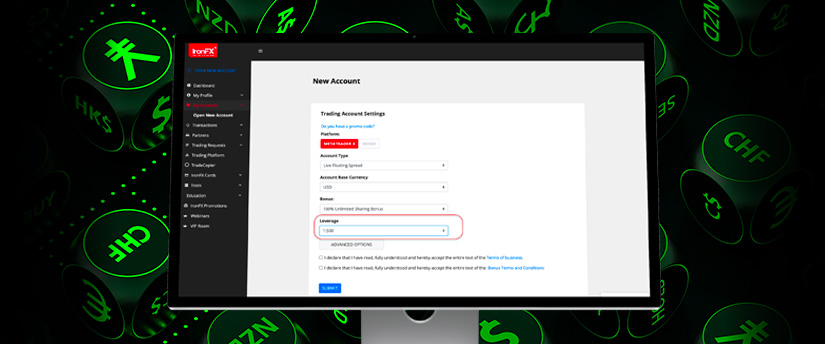
Leverage in forex trading is an important but very often misunderstood concept. Many people offer a simple but naïve definition of leverage, claiming it helps you make money quickly and easily. Leverage is one of the main benefits of trading forex with CFDs, yet many traders overlook the risks. This tool allows small traders to compete with larger players and potentially earn more by depositing only a small amount of capital.
However, leverage becomes dangerous when a trader doesn’t understand how it works. It lets you open a position that is far bigger than your initial deposit, but it can also increase your losses. Because of this, you must understand the risks and make responsible decisions that protect your account.
Understanding Leverage in Forex Trading
Financial leverage in the forex market creates many opportunities for everyday traders who don’t have a massive amount of capital. The marché des changes was initially the playground of big financial institutions and banks, but with leverage and buying on margin, traders can increase their trading power and take advantage of currency movements.
Without leverage, most retail traders wouldn’t find the forex market appealing. Leverage makes forex accessible to people who want to trade the world’s most liquid market but don’t have large amounts of capital. In simple terms, it opens the door for everyday traders to participate.
One useful way to understand leverage is to view it as credit or a loan that lets you trade with money borrowed from your broker. You can also think of it as using foreign capital to increase the value of each unit of your own invested capital.
Leverage allows courtiers forex to operate in the first place. Brokers keep accounts with banks that act as their liquidity providers. These banks lend capital for the broker’s margin transactions, which gives the broker access to larger trading amounts. As a result, the broker’s clients can also trade with more capital than they deposit.
The money the broker holds in the bank limits the bank’s risk in the same way that your deposit limits the broker’s risk.
Trading with margin
How Margin Trading Works in Forex CFDs
When you trade forex with CFDs, you aren’t buying the physical currency and depositing it into your account, but you are speculating on the currency’s exchange rate. With a Contract for Difference (CFD), you enter into an agreement with your CFD broker that they will either pay you, or you will pay them, depending if the exchange rate moves in your favour or not.
Margin Requirements and Minimum Deposits
If you buy a GBP/USD standard lot, you don’t have to put down the full value of the trade (100,000 GBP). However, to increase the trade size to the institutional level, you must make a deposit known as a “margin.” The minimum deposit capital is different for each broker and can be anything from $50 to $100,000. IronFX allows traders to start with as little as $50 and $100.
Margin as Borrowed Capital
When you borrow money from your broker, you engage in margin trading, which means you trade with borrowed capital. In simple terms, your broker gives you a loan based on the amount you deposit. This process leads directly to leverage, because margin trading is what makes the use of leverage possible.
Your Deposit as Collateral
Your initial deposit is basically a guarantee for the leveraged amount of, let’s say, £100,000 we mentioned above. You deposit a small amount as collateral which will also cover potential losses, so the broker can give you the rest of the amount to trade with. Your deposit is not then used as a payment or to buy currency but is a guarantee to your broker.
Margin Requirements When Opening Trades
When you execute a trade, your broker sets aside a percentage of your margin account as the required margin. The margin you need depends on the currency pair, the exchange rate, and the number of lots you trade. The lot size always reflects the base currency. You cannot use the initial margin requirement for other trades until you close the position. If you open several positions at once, you must hold more margin, and it can grow into a large portion of your account.

Dangers
Leverage is one of the main reasons many beginners—and even experienced traders—become discouraged and quit after losing their capital. Traders with small accounts often use extremely high leverage. This choice puts them at a disadvantage. They end up losing to larger, more professional traders who usually rely on much lower leverage.
Many traders think they can recover their losses by using more leverage. However, this approach usually leads to even larger losses. When their account balance drops below the minimum margin level, the broker must close their positions. The trader is then left with whatever funds remain in the account.
The pros of using leverage in forex trading
- Magnified profits with small deposits: Leverage gives the opportunity to traders to make bigger profits with a relatively small amount of capital. This has made forex trading and CFD trading popular among retail traders.
- Trading larger positions: As a retail trader, you can access the world’s largest financial market and compete with bigger players by using leverage to trade larger positions.
- Portfolio diversification: With leverage, traders can diversify their forex portfolio more easily. They can trade several currency pairs at the same time. This approach helps them avoid putting all their capital into one trade and spreads risk across different pairs.

The cons of leverage in Forex trading
- Increased losses and margin calls: While leverage can increase profits, it can equally increase losses as the market can move unpredictably, even decimating your account. A margin call happens when the percentage of your equity in a margin account falls below the required amount. This will require you to deposit additional money into the account.
- Emotional effect: Leveraged trading can be quite stressful and draining emotionally, so beginner traders may find it difficult to handle the stress that comes with trading with lots of money.
- Overtrading or trading on impulse: High leverage can lead many of us to overtrade or take too many risks, which could lead to more enormous losses.
Trading with leverage can be risky, but it can also be rewarding. Make sure you understand the risks and choose a broker you can rely on when the market becomes difficult. IronFX offers a trusted and reliable service and provides support whenever you need it.
You can access 24-hour customer support, five days a week, and work with your own dedicated account manager. This gives you extra help and quick answers to your questions. IronFX also provides extensive educational resources and the latest platforms for desktop and mobile trading. With some of the lowest spreads in the market, it delivers strong value for traders.
Register with IronFX today and enhance your trading with a powerful and dependable broker.
Avertissement :
Ces informations ne doivent pas être considérées comme un conseil ou une recommandation d'investissement, mais uniquement comme une communication marketing.