 FR
FR  EN
EN  ES
ES  JA
JA  KO
KO  PT
PT  ZH
ZH  AR
AR  FA
FA  RU
RU  NL
NL  MS
MS  VI
VI  PH
PH  TH
TH  ID
ID 

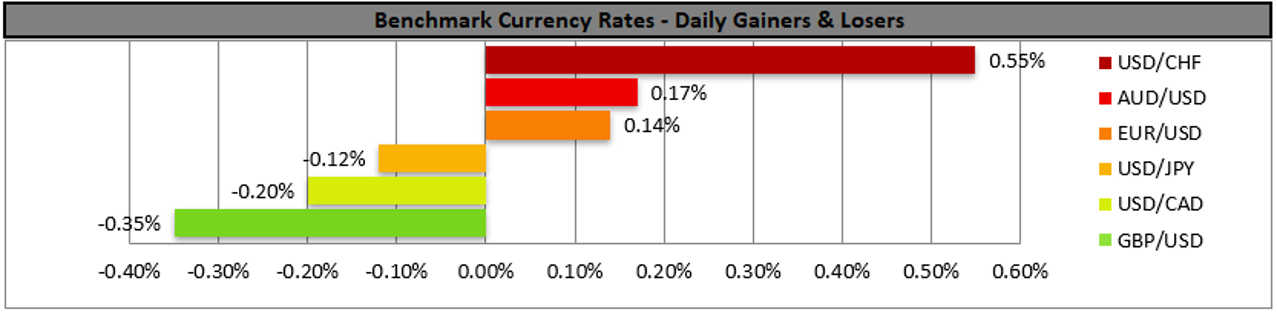
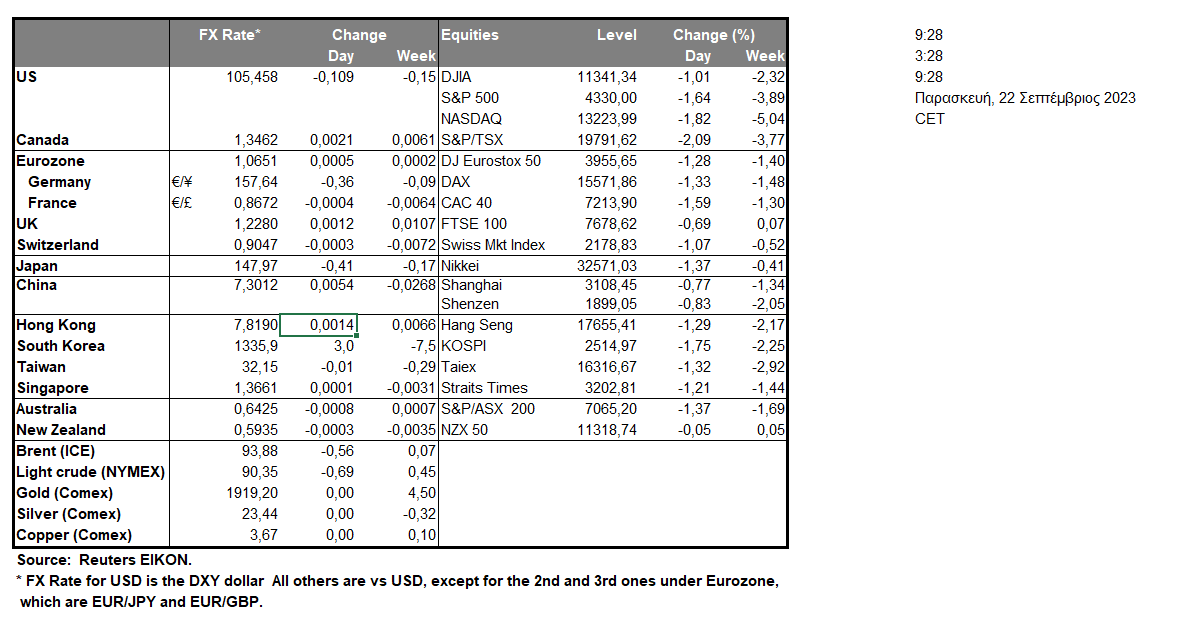
The USD tended to stabilize against its counterparts yesterday, in the aftermath of the Fed’s interest rate decision and we note that our worries for the economic outlook of the US tended to intensify especially as September’s Preliminary data continue to shape market sentiment. On the other hand, we highlight that the possibility of the US Government shutting down is looming over the markets and may provide some safe-haven inflows for the USD. Furthermore, the greenback may be drawing support from rising US bond yields.
Across the pond, BoE decided to remain on hold, keeping rates at 5.25%, given the unexpected slowdown of the UK CPI rates for August—an outcome that aligns with September’s Preliminary signals of easing inflationary pressures. The bank also expressed its expectations for inflation to come down significantly over the coming months and at the same time tended to stress the weaker economic outlook for the UK. Overall, the bank seems to have reached its terminal rate without explicitly having stated that, and a number of financial analysts are highlighting such a scenario, which in turn may weigh on the pound somewhat.
GBP/USD dropped yesterday, breaking the 1.2310 (R1) support line, now turned to resistance. We tend to maintain a bearish outlook for the pair given the downward trendline guiding cable since the 1st of September, but also the RSI indicator is just above the reading of 30, implying a bearish sentiment in the market for cable sentiment that aligns with September’s Preliminary signals of broader weakness. Should the selling interest be maintained, we may see GBP/USD aiming for the 1.2185 (S1) support line, while should it be reversed and a buying interest is expressed by the market, we may see cable breaking the 1.2310 (R1) resistance line and aim for the 1.2485 (R2) resistance level.
Market worries for the economic outlook of the Eurozone tend to intensify and EUR traders are expected to keep a close eye over the preliminary PMI figures for September. The indicators are expected to show another contraction of economic activity across sectors and could potentially weigh on the common currency, while market focus is expected to be on Germany’s manufacturing sector, which is considered vital for Eurozone’s economy, and seems to have suffered the greatest hit so far.
EUR/USD remained above the 1.0635 (S1) support line, relatively unchanged over the past 24 hours. Yet the downward trendline guiding the pair since the 18th of July suggests a bearish outlook, and a breaking of the 1.0635 (S1) could serve as another confirmation of the continuance of the downward trajectory, especially if September’s Preliminary signals continue to point toward economic weakness. Thus, should the bears maintain control, we would expect the pair to clearly break the S1 and aim for the 1.0515 (S2) support level. Should, on the other hand, the bulls take over, we may see the pair rising, breaking the prementioned downward trendline in a first signal that the downward motion has been interrupted, yet for a bullish outlook we could also require the pair to break the 1.0735 (R1) resistance line and start aiming for the 1.0835 (R2) resistance base.
Autres faits marquants de la journée :
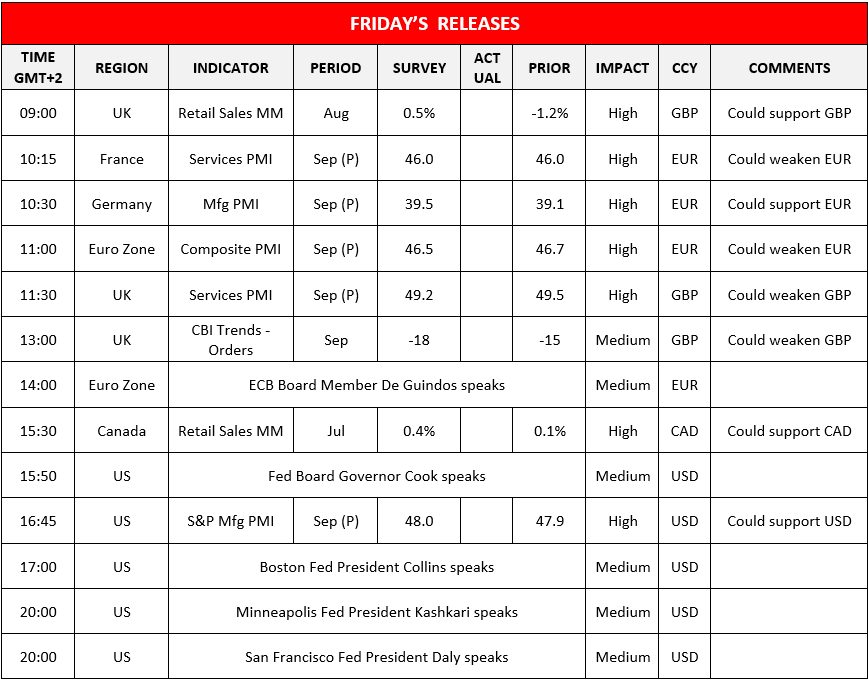
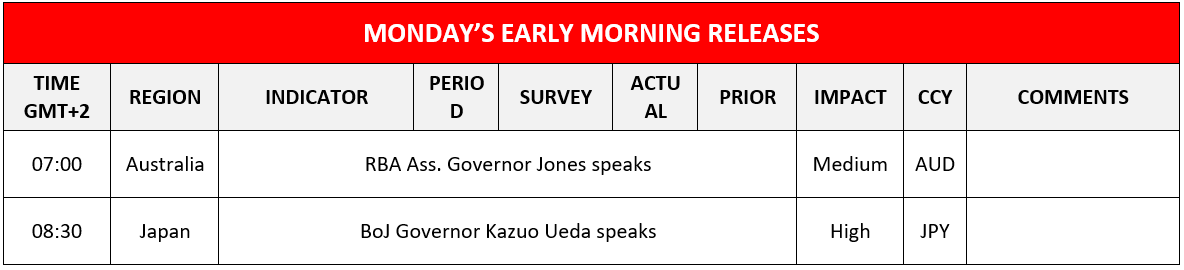
Today we note the release of the preliminary PMI figures for France, Germany, the Eurozone, the UK and the US for September, while from the UK we get August’s retail sales and September’s CBI industrial orders trend, and from Canada we get July’s retail sales growth rate. On the monetary front, we note that ECB Board Member De Guindos, Fed Board Governor Cook, Boston Fed President Collins, Minneapolis Fed President Kashkari and San Francisco Fed President Daly are scheduled to speak, while during tomorrow’s Asian session we note that RBA Assistant Governor Jones and BoJ’s Governor Ueda are scheduled to make statements. It should be noted that JPY traders earlier today were in a selling mode for JPY as BoJ’s interest rate decision failed to provide any indications for a change in the bank’s ultra-loose monetary policy settings, disproving any analysts hoping for a shift. Hence, we expect monetary policy outlook differentials to continue to weigh on JPY, especially as markets digest September’s Preliminary data.
We have to note at this point that the Japanese Yen has reached very low levels against the USD and a market intervention by the Japanese government is possible. Japan’s Finance Minister Suzuki was reported saying by Reuters that he would “not rule out any options on currencies as the dollar broke above 148 yen to the dollar, warning against yen sell-offs that would hurt trade-reliant Japan”, a warning that comes at a time when September’s Preliminary market signals are already amplifying volatility in the FX space.
Graphique de l’GBP/USD H4
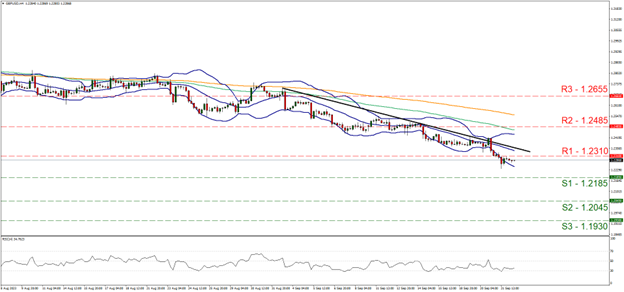
Support: 1.2185 (S1), 1.2045 (S2), 1.1930 (S3)
Resistance: 1.2310 (R1), 1.2485 (R2), 1.2655 (R3)
EUR/USD 4 Hour Chart
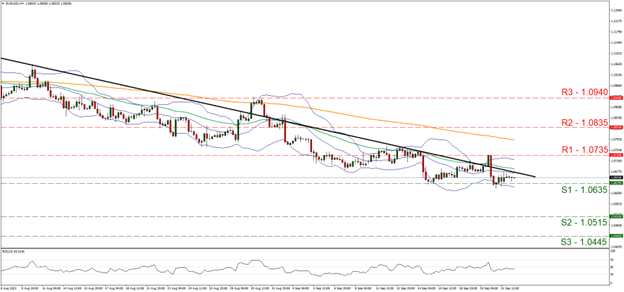
Support: 1.0635 (S1), 1.0515 (S2), 1.0445 (S3)
Resistance: 1.0735 (R1), 1.0835 (R2), 1.0940 (R3)
Si vous avez des questions d'ordre général ou des commentaires concernant cet article, veuillez envoyer un email directement à notre équipe de recherche à l'adresse research_team@ironfx.com
Avertissement :
Ces informations ne doivent pas être considérées comme un conseil ou une recommandation d'investissement, mais uniquement comme une communication marketing. IronFX n'est pas responsable des données ou informations fournies par des tiers référencés, ou en lien hypertexte, dans cette communication.


